 SoulNexus
Open in canvas ↗
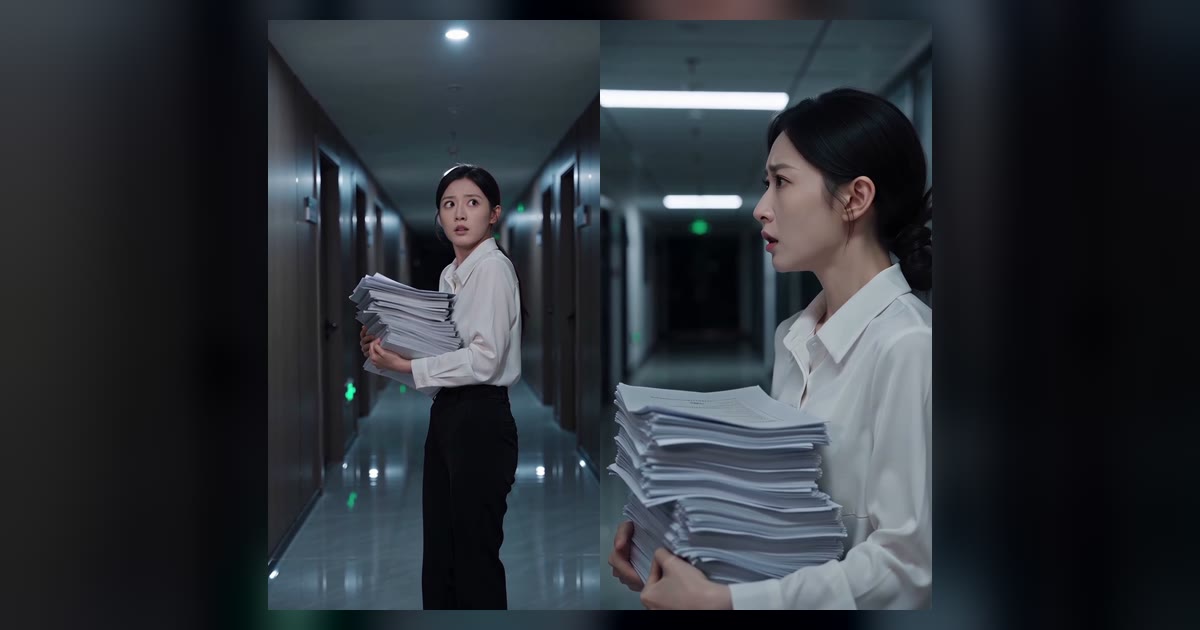
Short answer: AI video models overact when a prompt names an emotion ("alert eyes", "shocked") or asks the audience to notice a moment. Describe a sequence of physical beats instead: a starting state, one main action with direction and size, a small involuntary reaction, and an end pose, and say what the face should not do. With the same model, duration and scene, that change turned a wide-eyed, open-mouthed stare into a quick, believable glance back.
The two prompts
Both clips use Seedance 2.0 Mini 720p, 5 seconds, 9:16. We wrote the prompts in Chinese (shown in the Chinese edition); these are faithful translations.
Before: emotion words and an instruction to the audience
Vertical short-drama shot.
An office corridor late at night, cold white ceiling lights receding into the distance.
A young office worker holding a stack of files walks in quickly from the right, heels clicking; at the center of the frame she stops short, her shoulders tighten, she looks back at the empty corridor, eyes alert, breathing shallow.
Static medium shot, eye level, slight handheld shake, so the audience clearly sees her look back.
No subtitles, no text.
After: beats, a hand tell and a restrained face
Vertical short-drama shot, office corridor late at night, cool cinematic tones, slight handheld shake.
A young woman walks past quickly holding a stack of files.
Her steps slow first, she pauses for a beat, then turns her head to glance behind her, her fingers unconsciously pulling the files a little closer, and she turns back and walks on faster.
Restrained expression, brows only slightly drawn together, no wide eyes, no open mouth, not looking at the camera.
What changed on screen
Before | After | |
|---|---|---|
Face | Wide eyes, open mouth, held for over a second | Brief glance; brows drawn together, mouth closed |
Where the emotion lives | On the face only | In the timing (slowing down, the pause) and the hands |
Reads as | A reaction shot from a horror trailer | Someone who heard something and decided not to stop |
The prompts differ in more than one place (camera notes and wording too), so treat this as a demonstration of the recipe rather than a controlled experiment.
The motion recipe
Start: what the character is already doing, with their hands busy (carrying, holding, adjusting something).
One main action: give it a direction and a size: "turns her head to glance behind her", not "looks around nervously".
A small reaction, half a beat late: one or two involuntary tells such as a tighter grip, a swallow or a held breath. Never more than two.
End pose: where the body ends up and which way it is facing relative to the camera.
Then add one line about what the face should not do. Negative instructions are blunt, but they reliably remove the stock "shocked" face.
[Shot type], [place and light].
[Character] [what their hands are busy with] [starting movement].
First [slow down / small change], pause for a beat, then [one main action: direction + size].
[One involuntary tell: grip, swallow, breath], then [end pose and direction relative to the camera].
Restrained expression: no wide eyes, no open mouth, not looking at the camera.
Rules that keep the performance human
Replace adjectives with timing. "Pauses for a beat, then..." carries more feeling than "nervous".
Hide the emotion behind a purpose. She keeps walking because she wants to get away, so the fear shows as speed, not as a face.
In dialogue, one person acts and the other reacts half a beat late. Two people emoting at once looks staged.
Never ask the audience to notice something ("so viewers can see..."). The model answers by exaggerating it.
Do not let anyone look into the lens unless the shot is meant to break the fourth wall.
What still went wrong
Around the fourth second the frown is stronger than "slightly drawn together".
The prompt said "walks on" without a direction, so she turned and walked away from the camera instead of continuing past it. Write "keeps walking toward the camera and exits frame left" to pin it down.
This recipe is also built into the storyboard and video rules of new projects in the SoulNexus drama workbench, together with three-view character sheets for consistent faces.
FAQ
Does this work with other video models?
We only tested Seedance 2.0 here, but the principle (concrete beats instead of emotion labels) matches how screen actors are directed, and it costs nothing to try on any model.
Should I add timestamps for each beat?
We write the beats in order with connecting words ("first", "pause for a beat", "then") instead of timestamps. For a 5-second shot, three or four beats is the limit.
What if the character needs to show a strong emotion?
Give the strong emotion a big action (slamming a drawer, walking out) and keep the face neutral. The audience reads the action and fills in the face.
How we tested
Both clips were generated with the Seedance 2.0 Mini 720p option, 5 seconds, 9:16, one take each, both on 26 October 2026. They are shown unedited apart from compression for the web.
Sources
Try this prompt
Vertical short-drama shot, office corridor late at night, cool cinematic tones, slight handheld shake. A young woman walks past quickly holding a stack of files. Her steps slow first, she pauses for a beat, then turns her head to glance behind her, her fingers unconsciously pulling the files a little closer, and she turns back and walks on faster. Restrained expression, brows only slightly drawn together, no wide eyes, no open mouth, not looking at the camera.
SOULNEXUS CANVAS
Your next story starts here.
Take this idea into your own creative space. You stay in control of when generation starts.
Open in canvas ↗